
The Embodied AI Inflection: A Humanoid Robotics Market View
1. Executive Summary
Mainsheet began tracking humanoid robotics closely in early 2024 following Figure AI’s deployment announcement with BMW in Spartanburg. While Agility Robotics had already demonstrated logistics applications through pilots with Amazon and GXO, the Figure-BMW partnership marked the first widely publicized humanoid integration inside a major automotive production environment. The significance was not the scale of deployment, which remained limited, but the expansion of credible use cases beyond warehouse logistics into industrial manufacturing.
Investor enthusiasm accelerated rapidly from there. By September 2025, Figure AI had raised a Series C financing at a reported $39 billion post-money valuation. That valuation exceeded Goldman Sachs’ projected 2035 humanoid hardware market estimate of $38 billion. The comparison does not necessarily imply that Figure is overvalued. It does illustrate how aggressively capital markets are pricing future adoption, commercial execution, and manufacturing scale that the industry has not yet demonstrated.
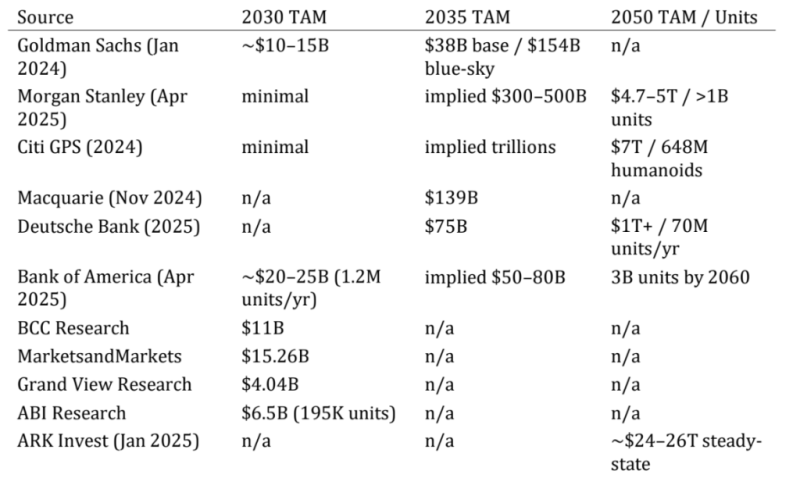
Published market forecasts vary widely. Goldman Sachs estimates a $38 billion humanoid hardware market by 2035. Morgan Stanley projects a broader humanoid ecosystem worth $4.7–5 trillion by 2050. Citi’s long-range estimate reaches $7 trillion, while ARK Invest places the long-term opportunity above $24 trillion. These forecasts are directionally useful but operationally limited. Most rely on assumptions about deployment scale, labor substitution, and cost reduction that remain unproven outside controlled pilot environments.
What has changed materially over the last two years is not the long-term vision, but the quality of operational evidence. Figure reported more than 1,250 operational hours at BMW Spartanburg, where Figure 02 handled over 90,000 sheet-metal parts during production of approximately 30,000 BMW X3 vehicles. Agility Robotics became the first Western humanoid company generating recurring commercial revenue through a multi year robotics-as-a-service agreement with GXO Logistics. In China, commercial deployment accelerated more aggressively. Chinese manufacturers shipped an estimated 13,000– 16,000 humanoids during 2025, with Unitree and AGIBOT accounting for the majority of volume. Western manufacturers remained substantially behind in unit production.
At the same time, hardware costs declined faster than most industry forecasts anticipated. Goldman Sachs estimated humanoid manufacturing costs fell roughly 40% between 2023 and 2025, from approximately $50,000–250,000 per unit to roughly $30,000–150,000, depending on configuration and sourcing. Chinese supply-chain integration appears to be the primary driver of that compression. Morgan Stanley’s Optimus teardown analysis estimated a fully localized Chinese supply chain reduced Tesla’s humanoid bill of materials by nearly two-thirds relative to Western sourcing.
The central issue for investors is that deployment economics still lag valuation assumptions. No humanoid platform has yet demonstrated the reliability, uptime, or maintenance profile required for large-scale unsubsidized deployment outside structured pilot programs. Mean-time-between-failure metrics remain well below industrial automation standards. Runtime limitations, dexterous manipulation challenges, and integration complexity continue to constrain real-world utilization.
The autonomous-vehicle sector provides the closest historical comparison. Cruise and Argo AI raised billions of dollars before failing to achieve economically viable scale. Waymo ultimately survived, but only after more than a decade of Alphabet-funded development. Humanoid robotics entered 2026 with valuations comparable to peak autonomous-vehicle financing cycles despite substantially lower revenue and limited production deployment.
For that reason, Mainsheet views the most attractive near-term exposure as infrastructure rather than broad integrator risk. NVIDIA remains the clearest example, capturing value through compute, simulation, training infrastructure, and strategic equity positions across the sector. Component suppliers, actuator manufacturers, and foundation-model platforms may ultimately prove more durable than many current humanoid OEMs. Among Western integrators, Agility Robotics currently has the strongest commercial positioning based on recurring revenue and deployed customer contracts. Figure AI, Apptronik, and Boston Dynamics remain important companies to monitor, but the next 24 months will likely determine whether current valuations can be operationally justified.
2. Market Size and Commercial Outlook
Forecast dispersion across the humanoid robotics market is driven primarily by differences in scope and time horizon. Goldman Sachs’ widely cited estimate measures humanoid hardware shipments only and projects a $38 billion market by 2035. Morgan Stanley’s projections include hardware, software, services, and supporting infrastructure, producing a substantially larger long-term estimate of roughly $5 trillion by 2050. Other institutions, including Citi, Deutsche Bank, and Bank of America, model similarly expansive outcomes based on assumptions of widespread household and industrial adoption.
These forecasts are not directly comparable. Some model annual hardware revenue, while others estimate the value of the broader labor and automation ecosystem humanoids could eventually address. The more useful observation is that nearly all major forecasts now assume meaningful commercialization within the next decade. That shift alone represents a substantial change from consensus views held only two years ago.
Near-term deployment data remains modest relative to long-term projections. Global humanoid shipments in 2025 totaled roughly 13,000–16,000 units, with Chinese manufacturers accounting for approximately 80% of volume. AGIBOT shipped more than 5,000 units during the year, while Unitree shipped over 5,500. By comparison, Tesla, Figure, and Agility each deployed only hundreds of units.
The gap reflects manufacturing maturity and supply-chain economics more than a pure technology deficit. Chinese humanoid manufacturers benefit from vertically integrated domestic supply chains, lower actuator costs, lower battery costs, and direct state support for industrial robotics development. Morgan Stanley’s analysis of Tesla Optimus estimated a roughly 2.8x bill-of-materials penalty when sourcing outside China.
Pricing across the sector remains highly fragmented. Unitree’s R1 launched at approximately $5,900, while Boston Dynamics Atlas is estimated above $400,000 per unit. Agility Digit operates primarily through a robotics-as-a-service model priced near $30 per hour, roughly in line with the fully burdened labor cost of U.S. warehouse workers operating across multiple shifts.
UBTech currently represents the clearest public-market benchmark for humanoid commercialization. The company reported RMB 820 million in humanoid-related revenue during 2025, driven by deliveries to automotive and industrial customers including BYD, Foxconn, Geely, and Airbus. Agility Robotics provides the second important benchmark. If Digit’s reported operating-cost reductions continue toward management targets, the economics for warehouse deployment could become commercially viable at scale within the next several years.
Additional cost and benchmark detail
Two specifics from this section are worth pulling out for investors building a model. First, Morgan Stanley’s Optimus Gen 2 BOM analysis estimates approximately $46K with full Chinese supply chain versus approximately $131K without — a 2.85x penalty for Western sourcing, with actuators alone running $22K (China) versus $58K (Western). Bank of America projects the typical humanoid BOM declining from approximately $35K today to $13K–17K by 2030–2035, roughly a 14% annual cost reduction. ARK frames the trajectory via Wright’s Law, citing EV battery costs as the analogous prior.
Second, Agility’s CEO Peggy Johnson has stated that operating cost for Digit is currently $10–12/hour and trending toward $2–3/hour at scale, against the $30/hour RaaS price and a fully-loaded U.S. warehouse worker cost of $26–34/hour. UBTech’s full-year 2025 humanoid revenue was RMB 820M on 1,079 Walker S units delivered, growing from RMB 35.6M the prior year. Those two data points — the operating-cost trajectory at Agility and the realized revenue at UBTech — are the most concrete commercial benchmarks the sector currently has.
3. Competitive Landscape
Figure AI
Founded in 2022 by Brett Adcock, Figure AI is currently the highest-profile Western humanoid company and among the most aggressively valued. The company raised a reported $1 billion+ Series C in September 2025 at a $39 billion post-money valuation.
Figure’s strongest asset is operational credibility. Its BMW Spartanburg deployment remains one of the few documented examples of sustained humanoid activity inside a major automotive production environment. Figure also built a dedicated manufacturing facility, BotQ, designed for scaled humanoid production rather than low-volume prototyping.
Technically, Figure has moved quickly. Figure 03 introduced lower-cost hardware, improved tactile sensing, swappable batteries, and the Helix vision-language-action architecture for upper-body control. The company also shifted AI development in-house after ending its OpenAI partnership in 2025.
The primary concern is valuation relative to demonstrated commercial scale. Revenue remains limited, production volumes are low, and the company faces increasing competitive pressure from lower-cost Chinese manufacturers. The November 2025 whistleblower lawsuit also introduced the first major public safety controversy in the sector, highlighting how little regulatory precedent currently exists around humanoid deployment.
Figure remains one of the strongest Western contenders, but current pricing assumes successful scaling well before that outcome has been operationally proven.
Tesla Optimus
Tesla’s humanoid strategy benefits from vertical integration, manufacturing infrastructure, and existing autonomy expertise. No other company can test humanoids inside factories at Tesla’s scale while simultaneously controlling battery systems, compute, actuators, and AI infrastructure.
The challenge is execution. Tesla repeatedly missed production targets for Optimus, and Musk acknowledged in early 2026 that the robots were not yet performing economically useful work inside Tesla facilities. China’s 2025 rare-earth export controls also exposed Tesla’s dependence on Chinese magnet supply chains.
The long-term upside remains substantial if Tesla can scale production and reduce costs through manufacturing leverage. The risk is that timelines continue slipping while competitors close the software gap.
Agility Robotics
Agility currently has the strongest commercial position among Western humanoid companies. Its deployment with GXO Logistics represented the first recurring humanoid robotics-as-a-service contract with a major enterprise customer.
Unlike many competitors, Agility’s valuation remains tied more closely to demonstrated deployment rather than speculative consumer narratives. Digit is already operating in warehouses under real commercial agreements, and the company’s RoboFab facility provides a path toward scaled manufacturing.
Agility’s hardware design also appears less exposed to rare-earth supply constraints than many competitors. That became more relevant after China tightened export controls in 2025.
The company still faces the same reliability and deployment challenges as the broader sector, but it currently has the clearest bridge between pilot deployments and repeatable commercial revenue.
Apptronik
Apptronik has assembled one of the strongest strategic investor groups in the industry, including Google, Mercedes-Benz, and John Deere. The company’s partnership with Google DeepMind is particularly important because it ties Apollo directly into one of the strongest AI research ecosystems in robotics.
Apollo is positioned as a general-purpose industrial humanoid rather than a single-use platform. Management has also been more restrained than many peers regarding deployment claims. The company acknowledged publicly in 2025 that most customer relationships remained in pilot stages.
That realism is useful. Apptronik may ultimately emerge as one of the stronger industrial platforms, but the company is still earlier in commercialization than current funding levels imply.
Boston Dynamics
Boston Dynamics remains the technical benchmark for locomotion and robotics engineering. Atlas benefits from decades of bipedal robotics research and one of the deepest technical teams in the industry.
Commercially, however, Boston Dynamics is still early. Most near-term Atlas deployments remain internal to Hyundai or tied to strategic research partnerships. Existing Spot and Stretch revenue help support development, but Atlas itself has not yet demonstrated scaled enterprise economics.
Boston Dynamics enters commercialization with substantial credibility, though likely on a slower timeline than more aggressively funded startups.
Chinese Manufacturers
China is currently the center of gravity for humanoid manufacturing scale.
Unitree has compressed the industry cost curve faster than any Western competitor. The company’s low-cost humanoids dramatically shifted pricing expectations across the market and demonstrated how quickly Chinese manufacturing scale can reshape category economics.
AGIBOT became the highest-volume humanoid producer globally within three years of founding. The company also benefited from unusually strong state support and aggressive investment into embodied AI datasets and training infrastructure.
UBTech remains important because it is the closest thing the market currently has to a publicly visible humanoid revenue model. Its automotive deployments and reported humanoid revenue growth provide one of the few large-scale commercial benchmarks available.
The broader implication is straightforward: Western firms currently lead in software ecosystems, enterprise relationships, and AI integration, while China leads in manufacturing scale, supply-chain efficiency, and hardware cost reduction.
That divide is likely to shape the industry for the remainder of the decade.
4. Technology Stack
Hardware Economics
Actuators remain the single largest cost component in humanoid robots, often representing more than half of total hardware cost. Precision reducers, motors, roller screws, and rare earth magnets dominate the bill of materials.
The supply chain is highly concentrated. China controls most global rare-earth refining and permanent magnet manufacturing, while Japanese firms still dominate several precision motion-control categories. Western humanoid companies therefore face both cost disadvantages and supply-chain risk.
This became more visible after China imposed export controls on rare-earth materials in 2025. Companies dependent on Chinese magnets experienced immediate production pressure.
The broader trend remains favorable. Hardware costs are declining rapidly, particularly as Chinese manufacturing scales. The open question is whether deployment reliability improves quickly enough to match those falling costs.
Embodied AI and Control Systems
The industry has largely converged around vision-language-action architectures. These systems combine visual perception, language understanding, and motor control inside a unified model stack.
This shift matters because earlier robotics systems required extensive task-specific programming. Modern VLA systems are designed to generalize across environments and tasks with less retraining.
Figure’s Helix, Google DeepMind’s Gemini Robotics, and NVIDIA’s GR00T ecosystem all represent variations of this approach.
The most important development may be cross-embodiment learning. Large datasets collected across different robot types are beginning to improve generalization and reduce training bottlenecks. If that trend continues, software capability could improve much faster than traditional robotics development cycles historically allowed.
Dexterity
Dexterous manipulation remains the hardest unsolved problem in humanoid robotics.
Walking, navigation, and basic mobility have improved substantially. Reliable human-level object manipulation has not.
Modern robot hands still struggle with slip detection, deformable objects, force control, and open-ended environmental variability. Most current deployments succeed because tasks are tightly constrained and highly repetitive.
Synthetic-data generation and improved tactile sensing are helping. NVIDIA, Meta, and several research groups have made meaningful progress in this area. Even so, reliable general-purpose manipulation remains several years behind the quality implied by many public demonstrations.
Energy and Runtime
Runtime remains a major operational constraint.
Most humanoids currently operate for only a few hours under moderate industrial workloads before requiring charging or battery swaps. That limits deployment economics in environments requiring continuous operation.
Battery swaps, wireless charging, and future solid-state batteries may improve the situation, but current systems still consume significantly more energy than human workers performing comparable tasks.
This remains one of the least discussed bottlenecks in the industry.
NVIDIA’s Position
NVIDIA occupies the strongest infrastructure position in the sector.
The company supplies onboard compute, simulation infrastructure, synthetic-data tooling, training hardware, and foundation-model tooling simultaneously. Nearly every major Western humanoid company depends on NVIDIA somewhere in its stack.
That structure allows NVIDIA to benefit regardless of which humanoid platform ultimately succeeds commercially.
5. Commercial Adoption
Automotive Manufacturing
Automotive manufacturing became the first meaningful humanoid deployment environment because it combines structured workflows, high labor costs, and sophisticated automation infrastructure.
BMW, Mercedes-Benz, Hyundai, Tesla, BYD, Foxconn, and other manufacturers have all deployed or tested humanoids in limited production environments.
The installed base remains small relative to total industrial labor demand, but automotive deployments now represent genuine commercial experimentation rather than purely promotional demonstrations.
Warehousing and Logistics
Warehousing remains the clearest near-term economic use case.
Labor turnover is high, tasks are repetitive, and facilities already operate around automation infrastructure. At current robotics-as-a-service pricing, humanoids are approaching labor-cost parity in certain high-utilization warehouse environments.
Agility’s GXO deployment remains the strongest evidence that the model can work commercially, though most deployments across the industry remain pilot-stage.
Healthcare and Aging Economies
Healthcare may become one of the largest long-term humanoid markets due to labor shortages in aging economies.
Japan, South Korea, Germany, and parts of Europe face structural caregiving shortages that automation may partially offset. Tasks such as patient transfer, room preparation, and logistics support are physically repetitive and operationally expensive.
The challenge is regulation. Healthcare deployment standards are far stricter than industrial environments, which will slow adoption timelines substantially.
Consumer Applications
Consumer humanoids remain early and highly speculative.
1X and Figure have both discussed household robotics, but current systems still rely heavily on teleoperation or tightly constrained autonomy. Existing products are better understood as transitional systems than fully autonomous home assistants.
Meaningful consumer adoption likely requires substantial improvements in reliability, dexterity, cost, and safety.
Most current market projections for household deployment appear premature.
6. The US–China Competitive Dynamic
China currently leads humanoid robotics in manufacturing scale, supply-chain integration, and production economics.
The country filed substantially more humanoid-related patents than the United States between 2020 and 2024 and now hosts most of the global humanoid supply chain.
That lead is supported by industrial policy. Chinese national and provincial governments have committed significant capital toward robotics, embodied AI, semiconductors, and automation infrastructure.
The rare-earth export controls imposed in 2025 reinforced how dependent Western robotics manufacturers remain on Chinese industrial inputs. Building alternative supply chains will likely take years.
At the same time, Chinese companies face barriers in Western enterprise markets around cybersecurity, data governance, and supply-chain trust. Those concerns may slow adoption of Chinese humanoids in the United States and Europe even where hardware pricing is superior.
The likely outcome is a bifurcated market: Chinese dominance in manufacturing scale and cost efficiency, with Western firms competing through software integration, enterprise relationships, and AI infrastructure.
7. Investment Landscape
Capital inflows into humanoid robotics accelerated sharply between 2024 and 2026. Valuations expanded faster than deployment metrics, driven largely by investor demand for embodied AI exposure.
Figure, Apptronik, Skild AI, Physical Intelligence, and 1X all raised capital at multi-billion dollar valuations despite limited commercial revenue.
The market currently prices the sector as though large-scale commercialization is inevitable. That assumption may ultimately prove correct, but the timeline remains uncertain.
Public-market exposure is still limited. Tesla provides the largest liquid humanoid proxy, though its valuation already reflects substantial Optimus expectations. NVIDIA remains the strongest infrastructure exposure. UBTech offers the clearest publicly traded pure-play humanoid manufacturer, though with significant volatility and execution risk.
For most investors, the cleaner opportunity may remain the supply chain rather than the integrators themselves. Compute providers, actuator suppliers, simulation platforms, and robotics infrastructure companies carry lower binary risk than individual humanoid OEMs.
8. Risk Factors
The primary technical risk is not locomotion. It is reliable manipulation in unstructured environments.
Current systems perform reasonably well inside repetitive workflows but degrade quickly as environmental complexity increases. Reliability standards required for unattended industrial deployment remain largely unmet.
Commercial scaling introduces additional challenges. Moving from pilot programs to sustained deployment requires maintenance infrastructure, integration support, workforce coordination, and uptime metrics closer to traditional industrial automation.
Competition from Chinese manufacturers also creates substantial pricing pressure. Western firms cannot currently compete with Chinese hardware economics on manufacturing cost alone.
Valuation risk may be the largest issue. Several leading humanoid companies are valued as though scaled deployment is already operationally inevitable. The autonomous-vehicle sector demonstrated how long commercialization timelines can remain even when technical progress is real.
The sector does not need to fail for current valuations to prove difficult to justify.
9. Investment Thesis
Humanoid robotics is transitioning from research and demonstration into early commercial deployment. That transition is real.
The sector now has credible industrial pilots, improving AI architectures, rapidly falling hardware costs, and labor-market conditions that support long-term automation demand.
At the same time, current valuations assume commercial scaling before reliability, deployment economics, and manufacturing maturity have been fully demonstrated.
For that reason, Mainsheet views infrastructure and enabling platforms as the strongest near-term risk-adjusted opportunity. NVIDIA, actuator suppliers, simulation infrastructure, and foundation-model platforms benefit from category growth regardless of which humanoid manufacturer ultimately leads the market.
Direct integrator exposure should remain selective and tied to demonstrated commercial traction rather than narrative momentum alone.
Agility Robotics currently has the clearest evidence of repeatable commercial deployment among Western humanoid companies. Figure, Apptronik, and Boston Dynamics remain strategically important but still face meaningful execution risk relative to current market expectations.
The long-term opportunity in humanoid robotics is likely substantial. The near-term challenge is separating genuine commercialization progress from valuation assumptions that have moved ahead of operational proof.
Disclosures.
This report is prepared by Mainsheet Ventures for informational purposes only and does not constitute investment advice, an offer to sell, or a solicitation of an offer to buy any security. Mainsheet Ventures structures SPV-based co-investment vehicles on a deal-by deal basis; this report is not an offer of any such vehicle. The information contained herein is based on sources believed to be reliable as of May 2026 but has not been independently verified. Past performance is not indicative of future results. All investments involve risk, including the possible loss of principal. Mainsheet Ventures has structured an SPV with exposure to Figure AI, disclosed at mainsheet.ventures. This report may not be reproduced, distributed, or transmitted without the prior written consent of Mainsheet Ventures.
Mainsheet Ventures | May 2026